Here's How Apple Uses 3D Printing for Apple Watch and iPhone Air - MacRumors
Skip to Content

Here's How Apple Uses 3D Printing for Apple Watch and iPhone Air

Apple today highlighted its use of 3D-printed titanium in a trio of devices, the step-by-step process involved, and a few benefits of the technology.
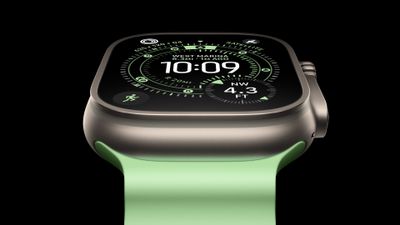
Apple Watch Ultra 3 hero 250909
The titanium case on Apple Watch Ultra 3 models, the titanium case on higher-end Apple Watch Series 11 models, and the USB-C port on the iPhone Air are all 3D printed with 100% recycled aerospace-grade titanium powder, according to Apple.

3D printing involves creating an object layer by layer with powdered metal, until it is as close to the final shape needed as possible. It is an additive process, meaning that materials are only used as needed, whereas conventional forging is a more wasteful process that involves taking a solid block of metal and shaving it down into a desired part.

Apple says its use of 3D printing enables Apple Watch Ultra 3 and titanium Apple Watch Series 11 cases to use just half the raw material compared to the equivalent previous-generation models. In total, Apple estimates that more than 400 metric tons of raw titanium will be saved this year alone thanks to this new process.

Apple is aiming to achieve carbon neutrality across its entire footprint by 2030, and 3D printing helps it get one step closer to that goal.

"A 50 percent drop is a massive achievement — you're getting two watches out of the same amount of material used for one," said Sarah Chandler, Apple's Vice President of Environment and Supply Chain Innovation, in the press release.

In addition to the environmental benefits, Apple said 3D printing improves waterproofing for the antenna housing in cellular Apple Watch models, as it provides better bonding between the metal case and the thin plastic strip for antenna signals.

Apple previously said the iPhone Air's 3D-printed USB-C port offers three benefits compared to one made with a conventional forging process: it is thinner, stronger, and uses 33% less material to be more environmentally friendly.

Apple goes on to detail its step-by-step process for 3D printing titanium Apple Watch cases. First, raw titanium is atomized into powder. Then, a machine with lasers uses that powder to build a set of cases layer by layer. Next, excess powder is removed from the cases. After the cases are separated, they are put through a final quality check.

The full article on Apple's website is a worthwhile read if you are interested in learning more.

Related Forum: Apple Watch

Popular Stories

iOS 26

iOS 26.4 Adds Two New Features to CarPlay

Tuesday March 24, 2026 1:55 pm PDT by
iOS 26.4 was released today, and it includes a couple of new features for CarPlay: an Ambient Music widget and support for voice-based chatbot apps. To update your iPhone 11 or newer to iOS 26.4, open the Settings app and tap on General → Software Update. CarPlay will automatically offer the new features so long as the iPhone connected to your vehicle is running iOS 26.4 or later....
Apple Business hero

Apple Unveils 'Apple Business' All-in-One Platform

Tuesday March 24, 2026 8:53 am PDT by
Apple today announced Apple Business, a new all-in-one platform that unifies device management, productivity tools, and customer outreach features. The service is designed to be a consolidated replacement for several of Apple's existing business-focused offerings, including Apple Business Essentials, Apple Business Manager, and Apple Business Connect. It provides organizations with a single...
AirPods Pro Firmware Feature

Apple Releases New Firmware for AirPods Pro 3, AirPods Pro 2 and AirPods 4

Tuesday March 24, 2026 12:31 pm PDT by
Apple today released new firmware for the AirPods Pro 2, AirPods Pro 3, and the AirPods 4. The firmware has a version number of 8B39, up from 8B34 on the AirPods Pro 3, 8B28 on the AirPods Pro 2, and 8B21 on the AirPods 4. There is no word on what's included in the firmware, but Apple has a support document with limited notes. Most updates are limited to bug fixes and performance...

Top Rated Comments

18 weeks ago

Apple is ignoring the massive energy cost of producing titanium powder and instead focusing on 3D printing efficiency and renewable electricity usage. This is a selective framing that helps meet sustainability targets without meaningfully reducing total energy consumption.
They're now using 50% as much raw material (titanium). Do you have any idea how much energy it costs to extract titanium from the Earth?

This is a significant achievement. Apple should be proud, and is right to to publicize this advance.
Score: 9 Votes (Like | Disagree)
18 weeks ago
I do love reading all the negativity and trying to find fault in everything.
At least Apple are proactively doing something and also create products that last which means less upgrades.

No business that makes things is going to be 100% green, net neutral etc. I dont believe any of it, but can recognise that Apple appear to be a lot better than 99% of the rest.
Look to fast fashion, plastics in the supermarket and everywhere else and the mountains of cheap crap if you want to get angry about something.
Score: 6 Votes (Like | Disagree)
18 weeks ago

Apple is ignoring the massive energy cost of producing titanium powder and instead focusing on 3D printing efficiency and renewable electricity usage. This is a selective framing that helps meet sustainability targets without meaningfully reducing total energy consumption.

Recycled or not there’s still massive costs to produce titanium powder. Should we not draw criticism for information not disclosed (recycled smelting costs and powdering process) or trust blindly that Apple is being 100% honest with this claim?
The big energy cost for titanium is extracting/making the metal (e.g., mining, transport, and refining), not shaping it. Apple is using recycled titanium powder and says the new process uses 50% less titanium for those cases. There are costs for powder production but using recycled titanium should substantially reduce start to end energy costs for Apple. If you’ve got data showing the total energy or CO₂ is unchanged, it’d be good to see it -- otherwise you're just guessing about total energy consumption and are doing what you are criticizing Apple for doing (selectively framing).
Score: 6 Votes (Like | Disagree)
AppleTLDR Avatar
18 weeks ago

Apple is ignoring the massive energy cost of producing titanium powder and instead focusing on 3D printing efficiency and renewable electricity usage. This is a selective framing that helps meet sustainability targets without meaningfully reducing total energy consumption.
It feels like you haven’t read the press release:

“100 percent recycled aerospace-grade titanium powder”

Apple sources the powder from industrial titanium waste streams. Some reclaimed from the aerospace industry and some is in house scrap.

But even if they weren’t using recycled titanium, producing a single watch case using this method uses 50% less titanium. They’re able to make twice as many cases with the same amount of material. So unless Apple Watch sales doubled, which is unlikely, there’s up to a 50% energy saving even if they were using raw titanium. Which they aren’t.
Score: 4 Votes (Like | Disagree)
turbineseaplane Avatar
18 weeks ago

Apple is aiming to achieve carbon neutrality across its entire footprint by 2030
Just a note that carbon "neutrality" isn't what it sounds like.

They have to purchase loads of carbon credits to offset their carbon output to make the claim of "neutrality".

There are many things one can read about this if interested.
Begin your searches with "Apple" and "greenwashing" and go from there.
Score: 4 Votes (Like | Disagree)
18 weeks ago
Interesting article to read. Looks like it helps with Apple's environmental goals. Would like Apple to have a polished aluminum finish for all the color options.
Score: 2 Votes (Like | Disagree)