

Airthings is a company known for its air quality sensors, and today it introduced its newest digital radon detector, the Corentium Home 2. Depending on where you live, you may or may not be aware of radon, but exposure to radon over time can lead to lung cancer, and many people aren't aware that there's radon in their homes.
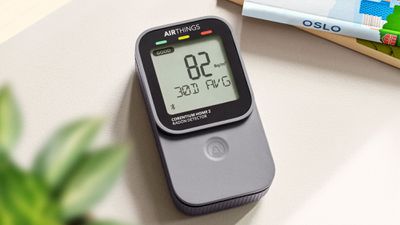
The Corentium Home 2 is a follow up to the original Corentium Home, and while it does not include HomeKit, it does have an iOS app that's able to connect to your iPhone over Bluetooth to deliver regular readings. It monitors radon levels, humidity, and temperature, and can send an alert if levels exceed a set threshold. When a reading is out of range, the display will let you know, so you can open the app to download the data to check in. Wi-Fi would be nice to have for continual data without the need to connect, but so far, the connection and data downloads have been quick and reliable.
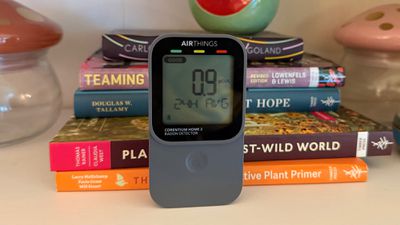
Design wise, the Corentium Home 2 is fairly simple. It's made from black plastic, with a small square screen where you can see the radon, humidity, and temperature readings at a glance. There's a button on the front that cycles through each view, and that's about it except for a battery compartment and a button inside the battery compartment that activates Bluetooth. It connects to an iPhone over Bluetooth to sync data to the accompanying app, and the app has the same straightforward design.
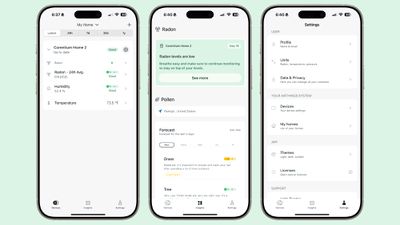
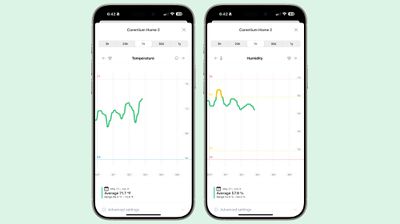
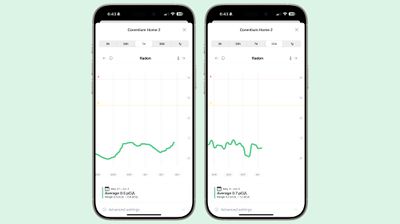
The app features current radon, humidity, and temperature levels, along with options to view results over time. Options include 24 hours, seven days, 30 days, and a year. You'll see averages over each time period, but you can also tap into each section for more granular data. When you're viewing data, the app has a neat haptic feature. When you tap along the line graph, rather than just jumping from one spot to another, it will quickly run through the different averages, which is useful for getting an in-depth look in just a few seconds.
The app and the graph use green for "good" radon readings, yellow for readings that exceed the good category, and red for danger zone readings, while it uses the same colors for humidity and adds blue for temperature. The app has built-in thresholds that aren't customizable, but seem to be based on generally accepted ideal indoor radon, humidity, and temperature settings.
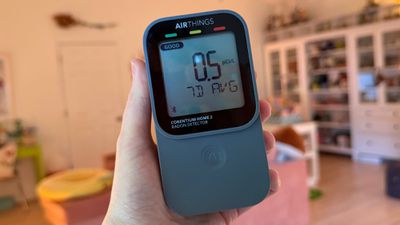
As long as radon readings are below 2.7 pCi/L (that's picocuries per liter), the app and the sensor won't raise an alarm. The yellow zone is between 2.7 pCi/L and 4 pCi/L, while the red zone is above 4 pCi/L. The U.S. Environmental Protection Agency suggests that people address radon at levels between 2 pCi/L and 4 pCi/L, with a stronger recommendation at above 4 pCi/L.
For temperature, the Corentium Home 2 green zone is between 64 and 77 degrees, the red zone is above 77 degrees (aka it's hot), and the blue zone is below 64 degrees (it's cold). Humidity is red above 70 percent and below 25 percent (these extremes are unpleasant for people and for wood floors and items in your home), yellow between 25 and 30 percent and also 60 and 70 percent, and green between 30 and 60 percent. The EPA recommends humidity levels between 30 and 50 for optimal comfort, but the Air-Conditioning, Heating, and Refrigeration Institute recommends between 40 and 60 percent. Drier air can lead to dry mucus membranes and an increase in infections, while moister air can cause mold. Ideals may vary based on climate and personal preference, so I do wish Airthings allowed the thresholds for temperature and humidity to be adjusted if needed.
You can opt in or opt out of alerts for radon, temperature, and humidity. Radon alerts are turned on by default, but can be toggled off in the app's settings, while the other options can be toggled on. Units of measurement can be changed in the app, and there's also an option to check pollen levels if you provide the app with your location.
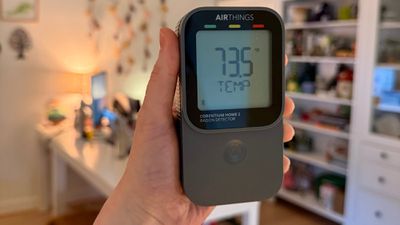
There are much more affordable temperature and humidity sensors on the market, so most people are likely going to want to pick up the Corentium Home 2 for the radon detection, with temperature and humidity readings serving as a bonus. There are multiple kinds of radon testing. Some are small packets of activated charcoal that you leave in place before sending them off to a lab, while there are also expensive professional level testing machines and mid-tier sensors like the Corentium Home 2.
The mail-in tests are the most affordable and the professional tests are the most expensive, but neither provides monitoring over time like the Corentium Home 2 does. Radon is a significant enough issue that if you're in an area with radon levels that are known to be high, keeping an eye on radon levels over time can provide peace of mind.
The EPA has a radon zone map [PDF], and much of the U.S. has high to moderate potential for indoor radon levels over 2 pCi/L. Radon comes from soil, rock, and groundwater, and it can seep into your home without you knowing because it is invisible and has no odor. The EPA estimates that there are 21,000 radon-related lung cancer deaths each year, and there is no established "safe" level of radon exposure. Exposure is continuous even at low levels, and it is the leading cause of lung cancer in people who do not smoke.
I had average radon levels of 5.7 pCi/L in my house, and it sometimes spiked to 8 pCi/L, so I am familiar with radon and radon testing. I have had my home radon tested several times, before and after a radon mitigation system was installed. I don't have a recent professional test (the last was in 2023), but the levels that the Corentium Home 2 show are in line with the results of the post mitigation testing that I had done (below 2 pCi/L on average).
The Corentium Home 2's radon readouts appear to be accurate to me, as are the temperature and humidity sensors. I have several SensorPush sensors that I use regularly and that are calibrated, and the Corentium Home 2 is generally within a percent on both temperature and humidity each time I've checked.
Even with a radon mitigation system, an option to see radon levels continually prevents anxiety over spikes in concentration and settles the question of whether mitigation is working. Radon levels can fluctuate quite a bit depending on outdoor conditions, time of year, and other factors, plus they can vary by room, so the other great thing about the Corentium Home 2 is that you can move it around and make sure there are no hot spots.
Radon monitors are typically placed in the lowest area of the home (that's where the gas settles), and several feet from a door or window that's opened regularly, because that can affect the readout. With the Corentium Home 2, you'll get your first reading within 24 hours, and continual readings after that. You need to test for around 30 days to get a clear picture of radon over time, and data will download from the device to the app each time you open up the app.
If it turns out that you do have a radon issue, the app can provide information on what to do about it. You can also turn on a "Connect with a professional" setting that will automatically contact a local company that deals with radon if you get a high reading, but I think most people are intelligent enough to seek out their own help.
The Corentium Home 2 operates on two AA batteries. I'm not yet sure how long the batteries will last, but AA is a battery type a lot of people keep on hand, and battery use seems minimal given that data is transferred over Bluetooth.
Bottom Line
Most of us have carbon monoxide sensors and smoke detectors in our homes, but radon can be just as dangerous. The Corentium Home 2 is $180, which feels like a reasonable price to pay to be able to keep an eye on radon fluctuations over time.
If you don't have a radon mitigation system or aren't familiar with radon, it can let you know if there's a problem. If you do have mitigation already and are aware of an issue, it can let you know that your system is working as intended.
How to Buy
The Corentium Home 2 can be purchased from the Airthings website or from Amazon for $180.


















Top Rated Comments
For example for the UK https://www.ukradon.org/information/ukmaps
To get it into HomeKit, I use the Homebridge plugin "homebridge-airthings". This links the Radon reading as a "leak detector" so I get alerts if it gets abnormally high (time to open a window). From its readme, there is no mention of the Corentium device, but it supports all the Wave variants and the View models. So, again, it seems like if you want to integrate with HomeKit, you should pay a few bucks extra to get the Airthings View instead of the Airthings Corentium, and then can also integrate to HomeKit using Homebridge.