Earlier this month, we shared an iPhone case called the Reach79, which debuted at CES. The Reach79 case claimed to boost the signal strength and performance of the iPhone, improving battery life, reducing dropped calls, and improving download speeds, statements that were quite controversial in our forums.
Readers were understandably skeptical of the Reach79's promise that it could deliver up to 2x stronger signal strength, so GeekWebGuides decided to go hands-on with the Reach79 case to see if we could prove the company's claims.
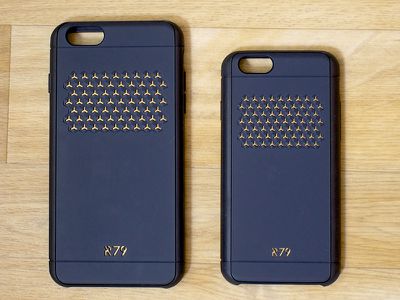 We've been extensively testing the Reach79 case on an iPhone 6 Plus for more than a week in various areas around the San Francisco Bay Area, but after several days of use, it remains difficult to conclusively say that the case improves signal in a meaningful way due to mixed test results. For a quick summary of what we found, scroll down to the "Bottom Line" section, or read on for our full results.
Our Testing
We used the Reach79 case on an iPhone 6 Plus connected to the AT&T network on multiple days, at multiple times, and in multiple locations, both indoor and outdoor. The phone was put into Field Test mode so that signal strength could be viewed as a raw decibel number rather than as dots or "bars," in order to better determine if and when the case was improving signal. All testing was done in the hand or up against the head, which is how the case is designed to work.
We also tested with the Ookla Mobile Speed Test app to see if the case improved data speeds, but we were told that this is not a particularly reliable testing method due to the many factors that can affect data transfer.
If there's one word that sums up our testing, it's inconsistent. At times, when the Reach79 case was placed on the iPhone, signal definitely improved as evidenced by the raw numbers and speed tests, but just as often, putting the case on did nothing to improve signal, or even seemed to degrade it somewhat.
What was most frustrating during testing was the fact that it was nearly impossible to repeat a test result more than once. When we did see signal improve while using the case, removing it and trying again often did not give the same level of improvement or gave none at all, in the exact same location.
Continuous signal fluctuation and the inability to see repeatable test results made it difficult to determine the degree of improvement the Reach79 offers, and the many factors that contribute to a cell phone's connection to a tower, including distance and orientation, gave us no way to create a test that could give concrete results. As a result, we can only offer anecdotal evidence of what we experienced while using the case.

We did see some instances of notable improvement when using the Reach79 case as opposed to using a standard silicone Apple iPhone case or the bare phone. For example, in one area where AT&T signal is not usually available and calls tend to cut out, we were able to make and maintain a seven minute conversation with no interruptions or distortion. In this event, putting on the case improved signal from roughly -120 (one bar) to -99 (two bars).
Out of several additional tests in the same spot, we were able to repeat the results approximately half of the time, with the person on the other end of the line saying the calls with the case were "crisper" and somewhat less distorted than without it.
The above example is an instance where we saw marked improvement -- in most cases, the signal jumps we were seeing were much more subtle with slight speed test boosts, but we were seeing occasional improvements, suggesting the Reach79 case does work to some degree, at least some of the time. Note, however, that there were many times where we saw no improvement or some degradation in signal.
Reach79's Testing
In its press release, the Reach79 case was advertised as having been tested by CETECOM, a well-respected test and certification lab for mobile devices.
GeekWebGuides asked for the CETECOM test results, but Reach79 was not able to provide full results, sharing only end results and testing methodology, which can also be found on its website. The Reach79 was tested on LTE bands on AT&T and Verizon in a shielded anechoic chamber, with the transmitted power measured every 15 degrees in a sphere.
The strength of the signal from the phone to the cell tower was determined by sampling the radiated transmit power of the device every 15 degrees in a sphere around the device. The measured power values are integrated to give a single figure of merit referred to as TRP (Total Radiated Power).
The ability of the phone to receive signals from the cell tower was also determined by measuring the power received at the phone from an antenna positioned every 15 degrees in a sphere around the device. The integrated measurements provide a metric known as TIS (Total Isotropic Sensitivity). Lower TIS means the device can detect weaker signals.
CETECOM's results saw a max improvement of 3.0X stronger signal strength on the iPhone 6 with an average improvement of 1.6X, and a max improvement of 4.9X on the iPhone 6 Plus with an average improvement of 2.0X.
Reach79 also partnered with survey company AYTM to recruit 200 beta testers across 37 states for consumer speed testing of the case. Download speeds improved from an average of 3.8Mbps to an average of 5.8Mbps, while upload speeds improved from an average of 2.1Mbps to 2.6Mbps, but Reach79 had the same issues with testing in the wild as GeekWebGuides did -- there are so many variables that it's hard to get a solid feel for signal improvements.
The Technology Behind the Case
The Reach79 case uses a common engineering technique known as the aperture coupled patch. As described by Reach79's engineering team, this "transfers energy from the iPhone's antenna to excite the gold-plated antenna inside the case," which is engineered to resonate at cell phone frequencies.
When we originally covered the Reach79 case, some posters in our forums hypothesized that the Reach79 case was perhaps boosting signal by focusing it in a single direction, thereby increasing the directionality and potentially decreasing the signal in another direction when the phone is pointed away from a cell tower.

According to Reach79 CEO David Vigil and CTO Ryan McCaughey, the Reach79 case does not change the directionality of the iPhone's antenna, and thus does not result in a decrease in signal strength. Instead, they described the case as "boosting signal in all directions" by taking a "relatively small antenna" and adding an extension to make it work more efficiently when held up against the head or in the hand.
As described to GeekWebGuides, holding an iPhone in the hand blocks signal, and this is the scenario that Reach79 aims to improve through passive coupling that tunes and boosts the iPhone's signal. During its CETECOM testing as outlined above, the Reach79 was tested in a 360 degree sphere, and these results, according to the Reach79 team, showed no degradation in signal at any angle.
Reach79 believes that the variance that we saw in testing (sometimes no improvement, sometimes signal degradation) is based on uncontrollable factors like weather, network, and other people on the cell site at the same time. Without all of these outside variables, the company believes we would have seen improvement 100 percent of the time when using the case, as it saw in its CETECOM test results.
The Reach79 case was described to us as redirecting energy to make it "more efficient" through manipulating the antenna. In talks with GeekWebGuides, Vigil was adamant that the case works and that the technology behind its design is solid. "It's irrefutable that we're increasing signal strength," he said. "I'm convinced this product will not show up on [store] shelves if it doesn't work."
In the future, Reach79 plans to create cases that are more tuned to each specific carrier, launching, for example, separate AT&T and Verizon editions that will provide better signal improvement on each carrier. Reach79 has a long term vision that will see it continuing to provide better signal improvements for each successive iPhone.
The Reach79 case was tested on the LTE bands of AT&T and Verizon. At the current time, it is universal and will work with most U.S.-based carriers, including AT&T, Verizon, and T-Mobile, but Sprint is unsupported. A Sprint-specific case will be available for purchase in the near future.
Improvement Quantified
CETECOM's testing, Reach79's consumer test, our own testing, online reviews, and online testimonials suggest that the Reach79 has at least some capability to improve signal, but what does that mean in the real world? For example, if a person is 10 miles from a cell phone tower, how much improvement is the Reach79 case providing? Is it like being 1 mile away? 5 miles? 9 miles?
We asked Reach79 for concrete data on what the signal improvement could mean for the average consumer in these terms, but the company is still in the process of gathering that kind of data.
Reach79 says the case improves signal by 2 decibels on average, with a peak improvement of 3 decibels, which is, as Reach79 promises, a 2X improvement in signal strength. For comparison's sake, signal boosters you might install in your home, such as AT&T's Microcell, can boost signal by more than 50 decibels.
Because the decibel system is not linear, the increase in decibels may not be intuitive to most people. A two decibel improvement at a decent (three to five bar) signal strength may not be noticeable, but at a lower signal strength, it could (maybe) mean the difference between one bar and two bars.
At a very rough estimate, there are somewhere in the neighborhood of 11 decibels of difference between each successive bar on the iPhone, so a potential jump from -108 (one bar, potentially) to -106 (two bars) could result in enough signal strength to make a call when it was not previously possible, whereas an improvement from -75 to -73 (both five bars) makes little difference.
This is a simplistic explanation of cell phone signal, and in reality, measuring a two decibel improvement is a difficult task due to all of the factors that can influence signal, which is another reason why it's impossible to accurately test the Reach79 case outside of a lab.
According to Vigil, though two decibels of improvement doesn't necessarily sound impressive, it is a "significant" number for network operators and handset manufacturers because it represents an improvement (50 to 60 percent average improvement on LTE bands) that can mean better connection speeds for consumers and thus better customer service.
Case Design
The Reach79 case is made from a lightweight polycarbonate that the company says can protect the iPhone from drops of up to 6.6 feet. We did not test this, but the case certainly seems as sturdy as other protective cases that make similar claims.
The case itself is somewhat bulky, but not more so than other highly protective cases, measuring in at .40 x 2.81 x 5.58. It is sturdy feeling and rigid, which has the unfortunate side effect of making it exceedingly difficult to remove from the iPhone. The case protects the volume/power buttons, and has cut outs for the camera and mute switch. A rubber lip that goes over the sides of the iPhone keeps the phone's display from touching surfaces when face down.

Available only in black, the Reach79 has several V-shaped cutouts on the back that allow the embedded gold antenna to peek through. This is a feature that's cosmetic only, not affecting the function of the case, but it is a visually pleasing design.

Bottom Line
Given Reach79's CETECOM test results and our own experience with the Reach79 case, it seems that there's a good chance that this case does what it claims and boosts signal at least some of the time.
It's questionable whether that signal boost is worth $60 to $70, given the inconsistencies we experienced and the degree of the improvement when it does seem to be working. A two decibel improvement may not be valuable to most users, but for someone who has continually bad signal hovering between one and two bars, and accepts that the case might not work all of the time, the Reach79 case could potentially be worth purchasing.
Reach79 CEO David Vigil likened the purchase and use of the Reach79 case to using different octanes of gas. 87 octane gas is acceptable, he says, but at times, one might purchase 91 octane gas because it's better for the car and provides better performance, even though it's not necessarily readily apparent. Over the years, he believes the Reach79 case will provide a better user experience, much like using a higher octane gas might in a car.
How to Buy
The Reach79 case can be purchased from the Reach79 website for $59.99 (iPhone 6) or $69.99 (iPhone 6 Plus). Additional colors will be available in Q2 2015.